Designing a Scalable Intake & Enablement System for Educational Media
Organization: ArtCenter College of Design
Role: Associate Director (Internal Product & Operations)
Duration: 2 years
Organizational Context (ACO → Heavin)
ArtCenter Online (ACO) operated as a content-first initiative with high headcount and low delivery efficiency.
Requests were handled reactively, with no consistent intake, prioritization, or success criteria
Content strategy emphasized volume over outcomes
Despite a team of ~12, the group struggled to deliver usable, high-impact assets
After three months, leadership dissolved ACO and formed Heavin Studio, a lean educational media production group.
Team reduced to three
Mandate shifted from producing content → scaling educational impact under clear constraints
Objective: increase output, reduce waste, and create a sustainable operating model without adding headcount
Core Problem
Demand for educational media exceeded production capacity.
Requests routinely lacked clarity around:
purpose
format
distribution
level of effort
As a result:
Low-complexity work consumed high-cost production time
Central production became the default for all requests
Many completed assets were underutilized or unused
Product Approach
Rather than expanding headcount, we focused on reducing ambiguity, segmenting demand, and shifting work left.
I helped design and iterate an intake-driven prioritization system that changed how work entered the organization and how decisions were made before production began.
Redesigning the Intake & Production System
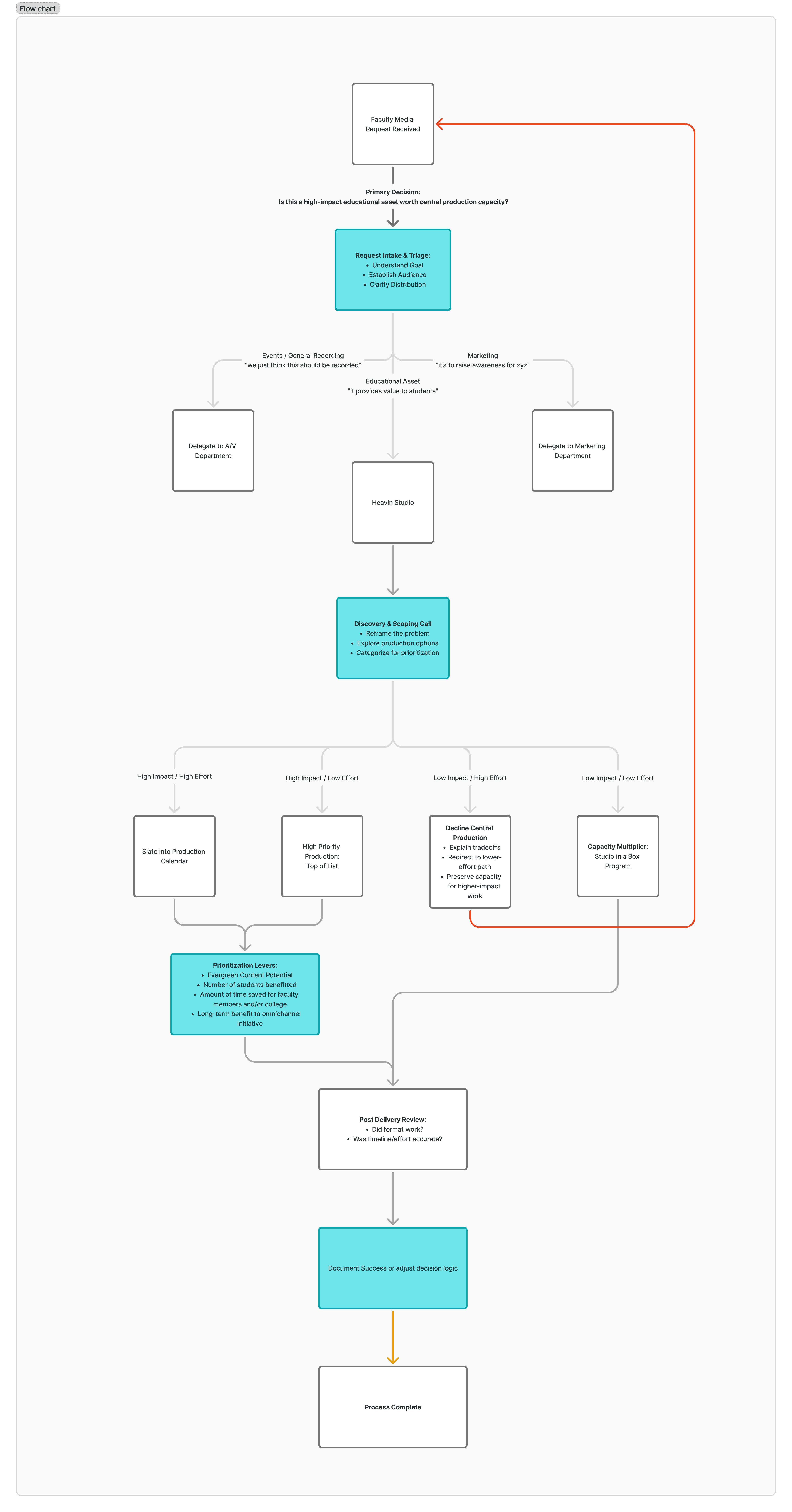
Operating model for intake, prioritization, and request routing
Requests were triaged through structured intake and discovery before being routed to central production, self-service enablement, delegation, or deliberate decline. Post-delivery review informed ongoing prioritization logic.
System Components
1. Intake as a Decision Gate
Problem
Recordings were requested without a defined use case or distribution plan.
Decision
Require requesters to define:
goal of the asset
intended audience
distribution channel
Outcome
Reduced wasted production time
Improved alignment at kickoff
Higher likelihood of asset adoption
2. Discovery & Scoping Layer
Problem
Faculty knew what content they wanted, but not the most effective format or level of effort.
Decision
Introduce a structured discovery call to:
validate demand
explore production models
prioritize work against available capacity
Outcome
Clearer scope before production
Fewer late-stage changes
Central capacity focused on highest-impact projects
3. Self-Service Enablement (“Studio in a Box”)
Problem
A high volume of low-complexity requests required in-person support from a very small team.
Decision
Shift repeatable work to a self-service model by:
repurposing unused COVID-era equipment
running faculty workshops
creating templates and guidelines
providing light consultation instead of full production
Outcome
Central team effort reduced by ~92% per request
~12 hours → ~1 hour of involvement
~12× increase in production efficiency
Freed capacity for high-impact work
Changing Default Decision-Making
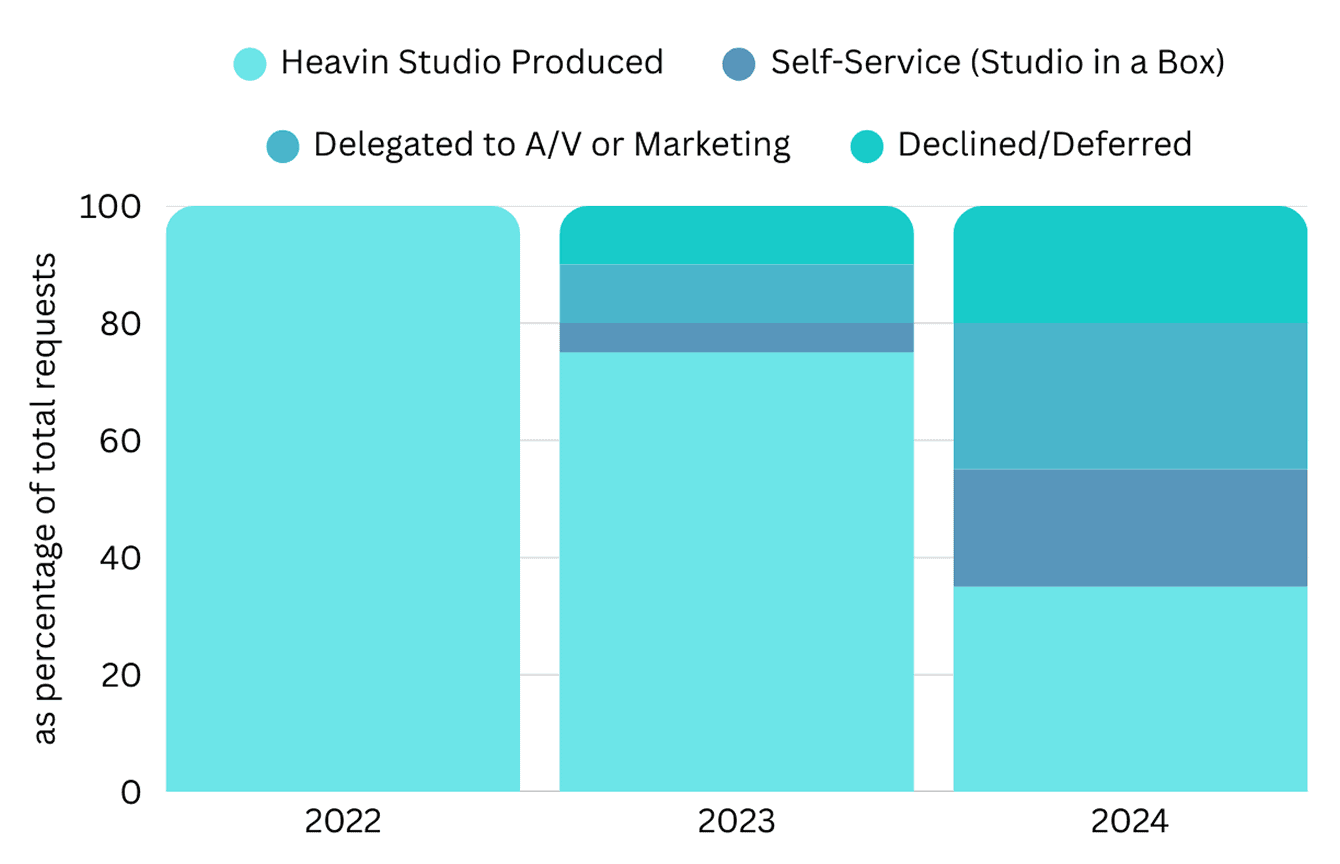
Request routing mix over time
Central production shifted from the default path to one of several deliberate outcomes, with increasing use of self-service, delegation, and explicit decline as the system matured.
System-Level Outcomes
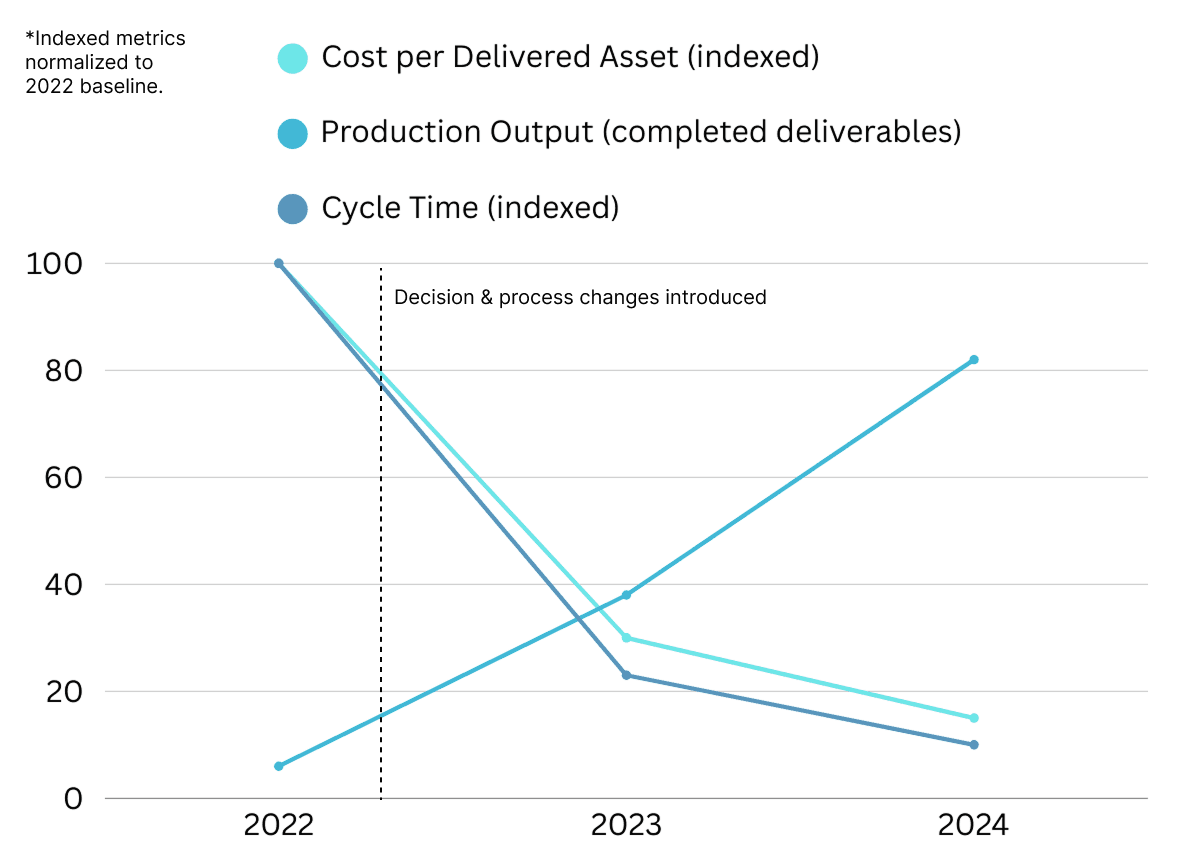
Efficiency gains following intake, prioritization, and enablement changes
Production output increased while cost per delivered asset and cycle time declined following the introduction of structured intake, prioritization, and self-service enablement.
Indexed metrics normalized to 2022 baseline.
Operating Model
Three-person core team
Daily syncs to:
track progress
reprioritize work
resolve blockers
Oversaw student workers across production and post-production
Continuous refinement of intake and routing logic based on usage and outcomes
Results (Year One)
80+ educational media productions delivered
Significantly higher throughput than the prior, larger team
Clear prioritization framework adopted across stakeholders
Scalable model achieved without additional headcount
Impact Summary
Overall
Output scaled ~13× in two years, while cost and cycle time both fell
Improvements achieved without adding headcount (team reduced from ~12 → 3)
Scaling came from system design, not increased effort
Throughput & Output
Annual deliverables grew from 6 (2022) → ~40 (2023) → ~80 (2024)
Represents a ~13× increase in completed work
Cost Efficiency
Cost per asset (indexed) dropped 100 → ~30 → ~15
~85% reduction in relative cost per deliverable
Driven by intake gating, reduced rework, and self-service enablement
Delivery Speed
Cycle time reduced ~90% overall
Shifted from 6–12 months → 8–10 weeks → 3–4 weeks
Enabled faster iteration and higher stakeholder trust
Demand Routing & Capacity
Central team ownership dropped from 100% → ~50% of requests
Remaining demand absorbed via:
~20% self-service
~20% delegated to partner teams
~10% declined or deferred
Central production became intentional, not default
Team Leverage
Low-complexity request effort reduced ~12 hours → ~1 hour
~92% reduction in per-request effort
Freed capacity for higher-impact, evergreen work
Net Effect
More output, lower cost, faster delivery — simultaneously
Created a repeatable operating model adopted across the organization